 |
A woman with HIV in her late 50s presents with unsteadiness after a fall. |
- History of Present Illness
A woman in her late 50s with a history of HIV (diagnosed approximately 20 years ago), CD4 nadir 107 cells/mm3, and recent improved adherence to bictegavir/tenofovir alafenamide/emtricibine (BIC/TAF/FTC) was admitted to the emergency department with recurrent falls. Six months prior, she experienced fevers, cough, night sweats, and weight loss and was found to have pneumonia. She was not taking antiretroviral therapy (ART) at the time but was restarted on BIC/TAF/FTC. Over subsequent months, she presented to the emergency department several times for dizziness and confusion.
Just prior to her current admission, she sustained a fall resulting in head trauma. She reported progressive unsteadiness, lightheadedness, weakness in all extremities, and numbness and tingling of her feet. She denied fevers, chills, or night sweats.
- Past Medical History
1. HIV: diagnosed approximately 20 years ago; CD4 nadir 107 cells/mm3
2. Pneumocystis jirovecii pneumonia
3. Oropharyngeal candidiasis
4. Opioid Use Disorder, on methadone maintenance therapy
- Medications
-
Amlodipine
-
Bictegravir-emtricitabine-tenofovir alafenamide
-
Methadone
- Social History
Unstable housing, intermittent heroin and cocaine use
- Physical Examination
Afebrile. Cardiac and pulmonary examinations were normal. Neurologic examination was notable for intact cranial nerves, normal upper and lower extremity strength, and absence of dysdiadochokinesis.
- Studies
Labs:
CD4 count: 241 cells/mm3
Creatinine: 1.55 mg/dL
WBC: 3.24 x 10³ /μL
MRI brain with and without contrast
-
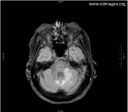
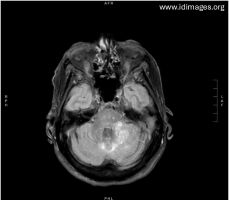
Innumerable foci of enhancement within the left greater than right cerebellum, extending into the brainstem, with associated leptomeningeal enhancement.
-
Moderate associated vasogenic edema. No significant mass effect or hydrocephalus.
 - MRI Brain without Contrast

- Diagnostic Procedure(s) and Result(s)
Lumbar puncture was performed. Cerebrospinal fluid (CSF) polymerase chain reaction (PCR) was positive for John Cunningham (JC) virus DNA.
- Treatment and Followup
- The patient was continued on antiretroviral therapy. Follow up imaging six months later demonstrated improvement.
- Discussion
This case illustrates unmasking PML-IRIS in a woman with advanced HIV and prolonged ART nonadherence who developed subacute, progressive cerebellar dysfunction after restarting BIC/TAF/FTC. The clinical timeline with neurological deterioration emerging within months of ART reinitiation in the setting of a rising CD4 count (from a nadir of 107 to 241 cells/mm3) is characteristic of immune reconstitution unmasking a latent JC virus infection.
The MRI findings of innumerable enhancing foci in the cerebellum and brainstem with leptomeningeal enhancement and vasogenic edema require careful differentiation from several entities. The absence of frank, discrete lesions, makes toxoplasmosis, cryptococcoma, syphilitic gummas and neurocysticercosis (NCC) less likely. The contrast enhancement and leptomeningeal involvement merits an evaluation for Primary Central Nervous System Lymphoma (PCNSL) with CSF cytology and EBV PCR testing. Cytomegalovirus (CMV) is also less likely given its predilection for the ventricles. Of note, while PML is classically non-enhancing, enhancement can be seen in the setting of IRIS (1).
Progressive multifocal leukoencephalopathy (PML) is a demyelinating disease of central nervous system caused by reactivation of JC virus, a polyomavirus that remains latent in most otherwise healthy individuals. In immunocompromised states, particularly advanced HIV, hematologic malignancies, or in patients receiving certain immunosuppressive therapies, JC virus can reactivate and infect oligodendrocytes, the myelin-producing cells that insulate neurons, resulting in multifocal white matter injury (2, 3).
Clinically, PML presents with progressive neurological disabilities that reflect location of CNS involvement (3, 4). Common manifestations include cognitive or language impairment, visual disturbances, motor weakness, and cerebellar signs such as ataxia, clumsiness, and gait instability (5). Symptom patterns vary by lesion distribution but often evolve sub acutely and progress over time (5).
PML-IRIS is a syndrome of paradoxical clinical worsening following immune restoration and reversal of immunosuppression. As the immune system recovers, it mounts an inflammatory response against JC virus in the CNS, resulting in both clinical and radiographic worsening (6). Treatment of PML-IRIS is largely supportive care with continuation of ART in those with HIV/AIDs (6).
- Final Diagnosis
Progressive Multifocal Leukoencephalopathy (PML) Immune Reconstitution Inflammatory Syndrome (IRIS).
- References
-
- Fournier A, Martin-Blondel G, Lechapt-Zalcman E, Dina J, Kazemi A, Verdon R, Mortier E, de La Blanchardière A. Immune Reconstitution Inflammatory Syndrome Unmasking or Worsening AIDS-Related Progressive Multifocal Leukoencephalopathy: A Literature Review. Front Immunol. 2017 May 23;8:577. doi: 10.3389/fimmu.2017.00577. PMID: 28588577; PMCID: PMC5440580.
PMID:28588577 (PubMed abstract)
- Whiteman ML, Post MJ, Berger JR, Tate LG, Bell MD, Limonte LP. Progressive multifocal leukoencephalopathy in 47 HIV-seropositive patients: neuroimaging with clinical and pathologic correlation. Radiology. 1993 Apr;187(1):233-40. doi: 10.1148/radiology.187.1.8451420. PMID: 8451420.
PMID:8451420 (PubMed abstract)
- Adang L, Berger J. Progressive Multifocal Leukoencephalopathy. F1000Res. 2015 Dec 10;4:F1000 Faculty Rev-1424. doi: 10.12688/f1000research.7071.1. PMID: 26918152; PMCID: PMC4754031.
PMID:26918152 (PubMed abstract)
- Berger, J. R., Pall, L., Lanska, D., & Whiteman, M. (1998). Progressive multifocal leukoencephalopathy in patients with HIV infection. Journal of neurovirology, 4(1), 59-68.
PMID:9531012 (PubMed abstract)
- Cinque P, Koralnik I, Gerevini S et al. Progressive multifocal leukoencephalopathy in HIV-1 infection
The Lancet Infectious Diseases, 9, 625-636
PMID:19778765 (PubMed abstract)
- Dunham SR, Schmidt R, Clifford DB. Treatment of progressive multifocal leukoencephalopathy using immune restoration. Neurotherapeutics. 2020;17(3):955-965. doi:10.1007/s13311-020-00847-0. PMID: 32166631.
PMID:32166631 (PubMed abstract)
- Notes
This case was contributed by:
Katelyn Pastick, MD- Infectious Diseases Fellow and Department of Medicine Chief Resident at Massachusetts General Hospital
Rocio Hurtado, MD- Assistant Professor of Medicine and Director of the MGH Mycobacterial Center, Massachusetts General Hospital
- Citation
- If you refer to this case in a publication, presentation, or teaching resource, we recommend you use the following citation, in addition to citing all specific contributors noted in the case:
Case #26001: A woman with HIV in her late 50s presents with unsteadiness after a fall. [Internet]. Partners Infectious Disease Images. Available from: http://www.idimages.org/idreview/case/caseid=627
Healthcare professionals are advised to seek other sources of medical information in addition to this site when making individual patient care decisions, as this site is unable to provide information which can fully address the medical issues of all individuals.
|
|